


 Munzir Hakimi
Table of Contents
Introduction
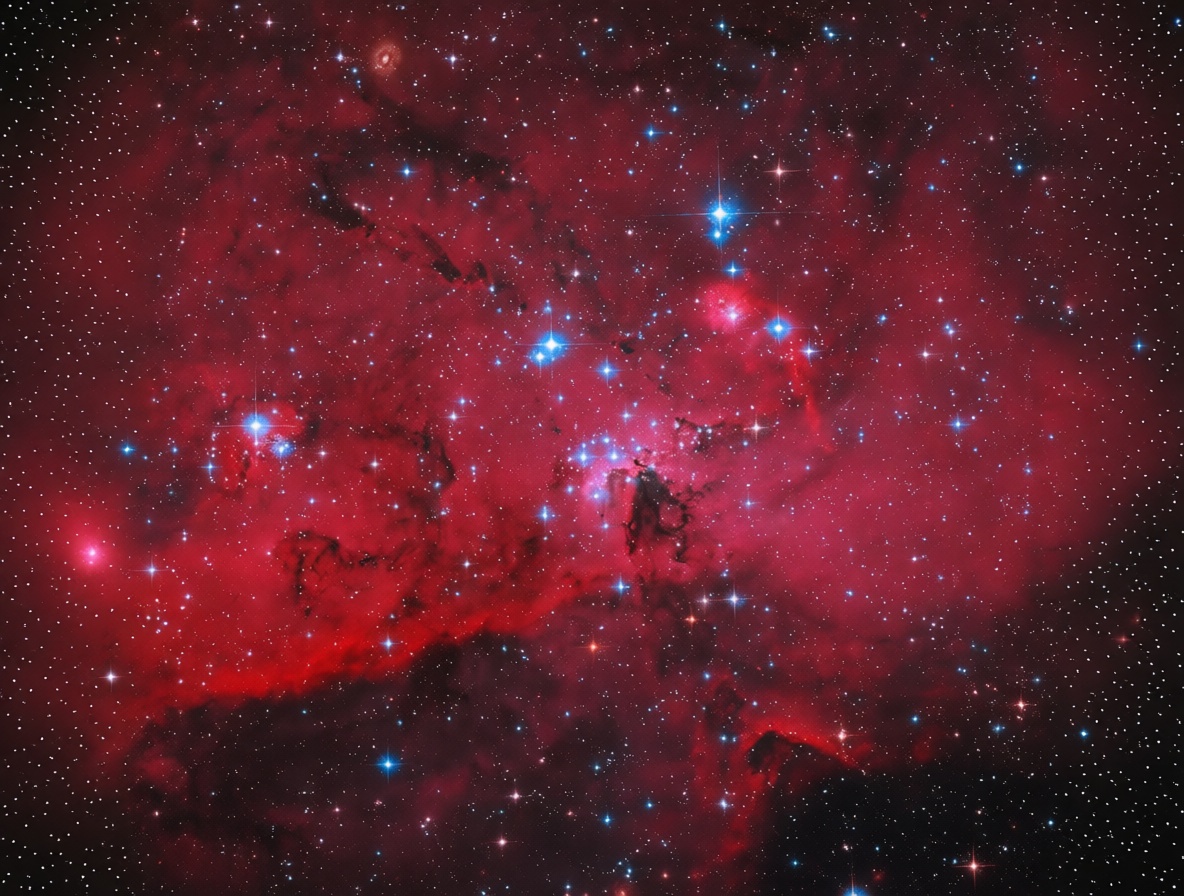
Tonight, a single image of a crimson gas cloud surrounded by brilliant blue and white stars is more than just a pretty picture—it’s a window into the birth of stars. That deep red glow is a stellar nursery, a place where new suns are just starting to flicker to life. When you look at it, you’re not just seeing light years away; you’re seeing the very process that created the atoms inside your own body. Astronomers are using these Hubble snapshots to rewrite what we know about how stars like our Sun are born. So why should you care? Because this cosmic scene is your origin story, and it’s playing out right now above your head.
Witnessing A Stellar Nursery In Action
Imagine standing in a dark field, looking up, and realizing that a crimson cloud you see is actually a bustling nursery where stars are being born. That’s exactly what Hubble captured—a glowing red cloud of gas and dust, dotted with hot blue and white stars. This isn’t a still photo from long ago; it’s an active, living process happening right now. The awe you feel is natural because you are watching creation unfold in real time.
Why does this matter for you? Because that feeling of wonder isn’t just entertainment—it changes how you see your own world. When you know that stars are born inside such clouds, every clear night becomes a reminder that the universe is alive and growing. Next time you glance up, you might pause and think: somewhere up there, a new sun is flickering to life. That shift in perspective can make your own daily struggles feel both smaller and more connected to something immense.
The Elements Around Us Were Forged In Stars
That same crimson cloud isn’t just a birthplace for stars—it’s a factory for the very elements that make up your body. Inside those fiery nurseries, hydrogen fuses into helium, and heavier atoms like carbon, oxygen, and iron are forged. When stars eventually explode, they scatter these elements across space. The iron in your blood, the calcium in your bones, and the oxygen you breathe all came from such stellar processes. It’s a humbling thought: you are literally made of stardust.
So what? That knowledge does more than satisfy curiosity—it connects your everyday life to the cosmos. The air you exhale was once part of a star. The metal in your phone originated in an ancient supernova. This isn’t poetry; it’s physics. When you feel small or lost, remember that you are a collection of atoms born from the same explosions that light up the night sky. That sense of belonging can bring a quiet comfort, grounding you in a story much larger than your own.
How Hubble Images Are Rewriting The Story Of Our Sun
Astronomers aren’t just taking pretty pictures—they’re using Hubble’s views of these crimson clouds to map exactly where and how stars form. By studying the dust, gas, and newborn stars in images like this one, they can reconstruct the birth of our own Sun. Every observation adds a new piece to the puzzle: How long does it take? What triggers collapse? Why do some clouds produce many stars while others make just a few? These are not abstract questions—they’re the story of your solar system’s origin.
This matters because the more we understand star formation, the better we grasp our own place in the universe. Your Sun was once a baby star inside a cloud like this. Knowing that changes how you see the daylight overhead—it’s not just a ball of fire, but a star that grew from cosmic dust. Next time you feel the warmth on your skin, you can think of the ancient crimson nursery that gave it life. That realization turns a simple walk outside into a moment of wonder.
Conclusion

When you look up at the night sky tonight, remember that the crimson cloud Hubble captured is not a relic of the past—it’s a snapshot of ongoing creation. Astronomers are using such images to piece together exactly how stars like our Sun are born, and every new discovery brings us closer to understanding our own origin. That knowledge is more than data; it’s a personal invitation to see the sky differently.
So the next time you step outside after dark, pause. Look for the faint reddish glow of a nebula. Know that inside it, new suns are flickering to life. Let that thought settle—you are part of a story that has been unfolding for billions of years. And with each glance upward, you are witnessing the next chapter.
What do you think? Does knowing Earth’s “delivery story” change how you feel when you look at the stars?